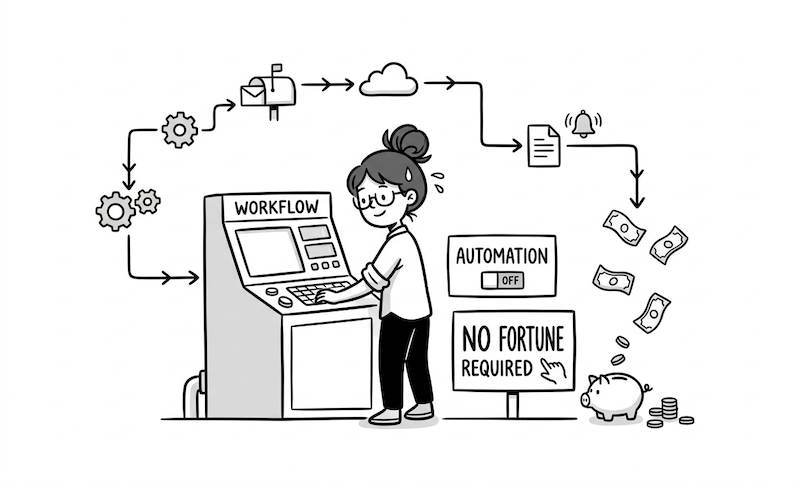
There’s a common myth floating around that if you want to automate your finance department, you need the budget of a FTSE 100 company and a team of Silicon Valley consultants. In the past, that might have been true—big tech usually came with a big price tag. But in 2026, the game has completely changed. Thanks to the “Democratisation of Tech,” some of the most powerful automation tools are now as affordable as your monthly Netflix sub. You don’t need a massive digital overhaul; you just need a few clever “plug-and-play” solutions.
The “No-Code” Revolution
The biggest secret to saving money in 2026 is No-Code and Low-Code platforms. In the old days, if you wanted a custom workflow, you had to pay a developer to write thousands of lines of code. Now, your average Finance Manager can build an automated approval process using simple “drag-and-drop” tools. It’s a bit like building with LEGO—you just snap the pieces together (e.g., “When an invoice arrives” + “Check it against the budget” + “Send to the boss for a thumbs up”). These tools often cost less than a round of drinks at the pub, yet they can save your team hundreds of hours a year.
The “Pay-As-You-Grow” Model
Another trend making automation affordable is the shift from “Big Bang” software purchases to SaaS (Software as a Service). Instead of buying a £50,000 system upfront, most modern finance tools work on a subscription basis. You can start small—maybe just automating your expense claims for £20 a month—and only add more features as your business grows. It turns a scary “Capital Expense” into a manageable “Monthly Operating Cost.” It’s the ultimate “try before you buy” approach, and it means even a tiny start-up can have a finance department that runs as smoothly as a global bank.
Using What You’ve Already Got
You’d be surprised how much automation is already sitting right under your nose. If your office uses Microsoft 365 or Google Workspace, you’ve already got access to powerful automation “engines” (like Power Automate) included in your license. People often go out and buy fancy new software when they could have solved their problem for free with a 10-minute YouTube tutorial and the apps they already use every day. It’s like buying a new car because you didn’t realize your current one has a “Sport” mode—sometimes you just need to know which button to press.
The Return on Investment (ROI) is Lighting Fast
When you automate a process, you shouldn’t just look at the cost; you have to look at the “hidden” savings. If a £50-a-month tool stops just one human error (like a duplicate payment) or saves your senior accountant five hours of data entry, it has paid for itself ten times over. In 2026, the average small business sees a return on their automation investment within six months. It’s one of the few areas where “spending money to save money” actually isn’t a cliché—it’s just good maths.
Start Small, Think Big
The trick to doing this on a budget is to avoid the “Everything Everywhere All at Once” approach. Don’t try to automate the whole department in a week. Pick one “pain point”—the thing that makes your team groan every Friday—and fix that first. Maybe it’s chasing late payments or reconciling the company credit card. Once that’s running on autopilot for a few quid a month, you’ll have the confidence (and the extra time) to tackle the next thing. Automation is a marathon, not a sprint, and in 2026, the entry fee is lower than it’s ever been.


xpklidtkehfovunvwhuyotwmkhwjkr